
How to navigate negative self talk

Negative self talk is an all-too-common experience that can greatly impact our emotional well-being and overall quality of life. It is the internal dialogue we have with ourselves that is self-critical, judgmental, and pessimistic. While it may seem harmless, negative self-talk can have significant and lasting effects on our mental health, including increased stress, anxiety, and depression.

Research has found that negative self-talk is associated with a range of negative outcomes, including decreased self-esteem, heightened anxiety, and even physical health problems such as headaches and insomnia (McKay & Fanning, 2016). One study found that individuals who engaged in negative self-talk had increased activation in the amygdala, a part of the brain associated with fear and anxiety. Another study found that negative self-talk was associated with decreased overall life satisfaction (Barnes et al., 2012).

How to improve your thinking

Negative self-talk can become a habit that is difficult to break, but there are several strategies that individuals can use to reduce its impact on their daily lives. One approach is to challenge negative thoughts by questioning their accuracy and exploring alternative perspectives. For example, instead of thinking, “I’m never going to be able to do this,” try reframing the thought as, “This is a challenge, but I’ve overcome difficult situations in the past.”

Another strategy is to practice self-compassion, which involves treating oneself with the same kindness, concern, and support that one would offer to a close friend. This can involve acknowledging and accepting one’s own imperfections and mistakes, and offering oneself words of encouragement and support in difficult times (Neff & Germer, 2013).

It can also be helpful to identify triggers for negative self-talk and develop strategies to avoid or manage them. For example, if a certain social media platform consistently triggers negative self-talk, consider taking a break from it or limiting the amount of time spent on it. If a particular person consistently makes negative comments that trigger self-criticism, consider setting boundaries or limiting contact with that person.

In addition to these strategies, practicing mindfulness and gratitude can also be effective in reducing negative self-talk. Mindfulness involves paying attention to the present moment without judgment, while gratitude involves intentionally focusing on things that one is thankful for. Both practices can help individuals cultivate a more positive and balanced perspective, which can help counteract negative self-talk.

In conclusion…

…negative self-talk can have significant negative effects on our mental and physical health, but there are several evidence-based strategies that can be used to reduce its impact. By challenging negative thoughts, practicing self-compassion, identifying triggers, and cultivating mindfulness and gratitude, individuals can take steps to improve their emotional well-being and quality of life. Remember, changing self-talk habits can take time and effort, so be patient and persistent in your efforts to cultivate a more positive and supportive inner dialogue.

References:

Barnes, L. L., Harp, D., & Jung, W. S. (2012). Reliability generalization of scores on the Spielberger State-Trait Anxiety Inventory. Educational and Psychological Measurement, 72(2), 476-483. https://doi.org/10.1177/0013164402062004005

McKay, M., & Fanning, P. (2016). Self-Esteem: A proven program of cognitive techniques for assessing, improving, and maintaining your self-esteem. New Harbinger Publications.

Neff, K. D., & Germer, C. K. (2013). A pilot study and randomized controlled trial of the mindful self-compassion program. Journal of Clinical Psychology, 69(1), 28-44.

Image from: https://www.sharp.com/health-news/the-importance-of-positive-self-talk

Killing two birds with one stone: how to improve wellbeing

Improving sleep and mental health with one lifestyle change: exercise.

Exercise has numerous benefits for our physical health, but it also plays a crucial role in our mental well-being. Studies have shown that regular exercise can improve sleep quality and reduce symptoms of anxiety and depression. In this article, we’ll explore the effects of exercise on sleep and mental health and provide some proven methods for finding exercises that bring you joy.

Effects of Exercise on Sleep

Insufficient sleep can have negative effects on our physical and mental health, leading to a range of issues such as increased risk for disease, weakened muscles, bones, and immune system, and mood disturbances. Exercise has been shown to improve sleep quality by increasing the amount of deep sleep we get. This, in turn, reduces the time it takes to fall asleep and decreases the number of times we wake up during the night.

A study published in the Journal of Sleep Research found that a 30-minute moderate-intensity exercise session in the morning improved the sleep quality of adults with chronic insomnia. Additionally, a meta-analysis of 23 studies showed that regular exercise resulted in significant improvements in sleep quality. The most significant improvements seen in individuals with insomnia.

Effects of Exercise on Mental Health

Exercise has been shown to have a positive impact on mental health, reducing symptoms of anxiety and depression. It’s believed that exercise triggers the release of endorphins, which are natural feel-good chemicals that can boost our mood and reduce stress levels.

A review of 49 studies found that exercise had a moderate-to-large effect on reducing symptoms of depression. The analysis showed that the greatest benefits were seen in those who exercised for at least 30 minutes per session, three to five times per week. Similarly, a study published in the Journal of Sport and Exercise Psychology found that aerobic exercise reduced anxiety symptoms in individuals with high levels of anxiety.

Finding Exercises that Bring You Joy

Finding an exercise routine that brings you joy is crucial for sticking with it long-term. Here are some methods for finding exercises that you enjoy:

  1. Experiment with different activities: Try out a variety of activities, such as hiking, swimming, yoga, or dancing, to find what you enjoy most. Don’t be afraid to step out of your comfort zone and try something new.
  2. Make it social: Exercising with friends or joining a fitness class can make the experience more enjoyable and motivating.
  3. Set achievable goals: Setting realistic goals, such as running a certain distance or lifting a certain weight, can give you a sense of accomplishment and help you stay motivated.
  4. Focus on the process, not the outcome: Don’t get too caught up in the end result. Instead, focus on the process of exercising and how it makes you feel.
  5. Make it a habit: Incorporate exercise into your daily routine, such as going for a walk during your lunch break or doing yoga before bed. This can help make it a habit and part of your lifestyle.

Conclusion

Regular exercise has numerous benefits for our physical and mental health, including improved sleep quality and reduced symptoms of anxiety and depression. By finding exercises that bring us joy, we can incorporate physical activity into our daily routine. This will enable us to reap the benefits of a healthier body and mind.

Sources:

  1. Kredlow, M. A., Capozzoli, M. C., Hearon, B. A., Calkins, A. W., & Otto, M. W. (2015). The effects of physical activity on sleep: A meta-analytic review. Journal of Behavioral Medicine, 38(3), 427-449.
  2. Kalak N, Gerber M, Kirov R, Mikoteit T, Yordanova J, Pühse U, Holsboer-Trachsler E, Brand S. Daily morning running for 3 weeks improved sleep and psychological functioning in healthy adolescents compared with controls. J Adolesc Health. 2012 Dec;51(6):615-22. doi: 10.1016/j.jadohealth.2012.02.020. Epub 2012 May 1. PMID: 23174473.
best valentine's day ever

How to harness your mind: mindfulness and meditation

Mindfulness and meditation are practices that have been shown to reduce anxiety and depression. There is strong evidence that supports that these practices can have a significant positive impact on mental health. In this blog post, we will explore the science behind mindfulness and meditation and why they are effective in reducing anxiety and depression.

What is mindfulness?

Mindfulness is a mental state in which we are fully present and aware of our thoughts, feelings, and surroundings. It involves paying attention to the present moment without judgment, and accepting our experiences as they are. Mindfulness is often practiced through meditation, but it can also be integrated into our daily lives by bringing awareness to everyday activities, such as walking or eating.

How does mindfulness reduce anxiety and depression?

Anxiety and depression are often characterized by negative thoughts and emotions that can become overwhelming and difficult to manage. Mindfulness can help reduce these symptoms by providing a new perspective on these thoughts and emotions.

Research has shown that mindfulness meditation can change the structure and function of the brain. Studies using brain imaging techniques such as fMRI have demonstrated that regular mindfulness practice can increase the density of gray matter in areas of the brain involved in emotional regulation, attention, and memory. These changes in the brain may be responsible for the observed improvements in anxiety and depression symptoms.

Let’s get specific…

One way that mindfulness can reduce anxiety and depression is by reducing rumination. Rumination is the repetitive and persistent focus on negative thoughts or feelings, and it is a common feature of both anxiety and depression. Mindfulness practice can help individuals become more aware of these patterns of rumination and learn to disengage from them.

Mindfulness can also improve emotional regulation, allowing individuals to better regulate their emotions and respond more effectively to stressors. It can also help individuals develop greater self-compassion and acceptance, reducing self-criticism and negative self-talk that can contribute to anxiety and depression.

What is meditation?

Meditation is a practice that involves training the mind to focus and become more aware of the present moment. There are many different types of meditation, including mindfulness meditation, loving-kindness meditation, and transcendental meditation. In general, meditation involves sitting quietly, often with eyes closed, and focusing on the breath or a specific object or affirmation.

The science

One clear way that meditation can reduce symptoms of anxiety and depression is by activating the parasympathetic nervous system, which is responsible for the body’s “rest and digest” response. This can help individuals feel more relaxed and less anxious.

Meditation can also increase the production of neurotransmitters such as serotonin and dopamine, which are involved in regulating mood and emotions. By increasing the levels of these neurotransmitters, meditation can help reduce symptoms of anxiety and depression.

Additionally, meditation can help individuals develop greater insight and self-awareness. This increased self-awareness can help individuals identify and change negative thought patterns that contribute to anxiety and depression.

Conclusion

Mindfulness and meditation are powerful practices that can have a significant positive impact on mental health. Through changes in brain structure and function, reduced rumination, improved emotional regulation, and increased self-awareness, these practices have been shown to reduce symptoms of anxiety and depression. If you are struggling with mental health issues, consider incorporating mindfulness and meditation into your daily routine to experience the benefits for yourself.

best valentine's day ever

How Therapy Works (Hint: it’s not magic!)

Sometimes therapy gets talked about in an elusive way, making it a bit confusing to understand. If you ask a friend who is in therapy what they do, you might get responses like, “I do talk therapy,” or “my therapist helps me sort things out.” Sometimes therapy seems to be a lot of talking, without emphasis on direction, change, or growth. But here at True Flourish Counseling, we believe that change and growth are an integral piece of the therapy puzzle. So how do we get there?

Therapeutic Environment

Therapy takes place in a safe environment where you can talk about what’s going on for you without judgment from the therapist or anyone else in the room. This might take place in a physical space or with the use of a HIPPA compliant video conferencing software. A good therapist will encourage honesty from their clients. They should utilize unconditional positive regard along the way so that the client feel safe expressing themselves fully.

Therapeutic Goals

It’s important that every client develop goals for therapy. This will help you and your therapist stay on track throughout the course of therapy, and will inform the type of therapy you do. During each session, there will be some time set aside for talking about whatever has come up for you throughout the week, as well as what brought you to therapy in the first place. We will spend time exploring different aspects of those issues and we might use different evidence-based exercises to help move you towards your goals.

What can I expect from my sessions?

You can expect to be treated with respect and dignity at True Flourish Counseling. You have a story, and we want to hear what it is! Your therapist will strive to create a judgement free space, and they will hold you accountable to refraining from unhelpful self-judgement as well. Your therapist wants to help you find your own answers, not come up with answers for you.

An example of a therapeutic approach: CBT

A very common and highly sought-after form of therapy is called CBT (Cognitive Behavioral Therapy). CBT is a form of psychotherapy developed by the Becks that focuses on how your thoughts, feelings and behaviors influence each other. It’s based on the idea that your thoughts directly affect your feelings and behaviors. CBT helps you to identify and change unhelpful patterns of thinking that may be contributing to distress or problems in your life. It’s a collaborative process between therapist and client to achieve your therapeutic goals.

Your therapist should help you understand how your thoughts, feelings and behaviors are connected. In this way, the therapist helps you to recognize patterns of behavior that may be holding you back in life. The goal is not necessarily to eliminate all negative thoughts or feelings but rather improve how they impact your life overall so that you are no longer stuck in patterns that do not serve you.

best valentine's day ever

Guilt vs. Shame & how to differentiate and manage both

Guilt and shame are two emotions that are often used interchangeably, but they have distinct differences in their meaning and impact on an individual’s life. According to renowned researcher and author Brené Brown, guilt and shame are not the same things and understanding the difference between the two is crucial for developing emotional resilience.

Guilt and shame defined:

Guilt is an emotion that arises from the belief that we have done something wrong or violated a moral or ethical code. It is often accompanied by feelings of regret and remorse, and it is focused on the behavior rather than the person. In contrast, shame is an emotion that arises from a sense of worthlessness or inadequacy about the self. It is a feeling that one is inherently flawed or defective, and it is often accompanied by feelings of humiliation, unworthiness, and self-loathing (Brown, 2012).

Guilt can be a positive emotion that can motivate us to change our behavior and make amends for any harm we may have caused. It is a socially adaptive emotion that is linked to accountability and responsibility. An important component of moral development, guilt can help us develop empathy and compassion for others. It helps us maintain social relationships by acknowledging our mistakes and taking steps to make things right. In contrast, shame is a destructive emotion that can lead to a downward spiral of self-doubt and self-criticism. It can erode our sense of self-worth and make us feel isolated and disconnected from others. Shame can make us feel like we are not good enough to be part of a community and can lead to feelings of loneliness and despair (Brown, 2012).

How do we manage guilt?

Guilt can be a temporary emotion that can be resolved by taking responsibility for our actions and making amends. It can lead to personal growth and help us become more resilient in the face of adversity. When we experience the discomfort of guilt in-the-moment, it influences us to become better decision makers so that we do not have to experience the same guilt again.

Here are a few ways that you can manage guilt:

  • Apologize to who you hurt & make things right in whatever way you can.
  • Do a body scan and see where the guilty feeling shows up in your body – how can you send peace and relaxation to that part of your body?
  • Journal about what events led up to your mistake and analyze how you can prevent the same mistake from happening again in the future (it might be helpful to do this with a therapist!)
  • If your mistake was a result of your needs not being met, figure out how you can get your needs met in a healthier way.
  • Refrain from negative self talk. Acknowledging a mistake is different from talking down to yourself – negative self talk is a result of shame, not guilt. If you begin sliding into this category, keep reading!

How can we manage shame?

In contrast, shame is a more persistent emotion that can be difficult to overcome. It can become an internalized belief about the self and can be a significant barrier to personal growth and development (Brown, 2012). Sometimes guilt can morph into shame if it is not resolved in a healthy way. For example, if we continue to beat ourselves up over a mistake, we may start to believe that we are inherently flawed and unworthy of love and belonging.

If you find yourself struggling with shame, I highly recommend trying to find a good therapist to help you work through it. A lot of time shame can be deep-rooted in messaging you have believed about yourself for a very long time. A good therapist will sit with you through the ups and the downs of working through this.

Conclusion

In conclusion, understanding the difference between guilt and shame is crucial for developing emotional resilience and maintaining healthy relationships. While guilt can be a positive emotion that motivates us to change our behavior and take responsibility for our actions, shame is a destructive emotion that erodes our sense of self-worth and can lead to feelings of isolation and disconnection. By learning to identify and cope with both emotions in a healthy way, we can build stronger relationships and cultivate a sense of self-worth and belonging.

References:

Brown, B. (2012). Daring greatly: How the courage to be vulnerable transforms the way we live, love, parent, and lead. Gotham.

Boost your Mood with Gratitude: How to Implement Thankfulness

Boost your mood with gratitude! Gratitude is a powerful emotion that has been shown to have numerous benefits for your mental health and social relationships. When you practice gratitude regularly, you can improve your mood, boost your self-esteem, and deepen your connections with others.

Here are some of the ways that gratitude can benefit your mental health and social relationships:

  1. Increases Positive Emotions: Gratitude can boost positive emotions, such as joy, contentment, and happiness. When you focus on the things that you are grateful for, you’re more likely to multiply these positive emotions.
  2. Reduces Negative Emotions: Gratitude can help to reduce negative emotions, such as envy, resentment, and frustration. When you focus on the things that you are grateful for, you’re less likely to dwell on negative emotions. Focusing on things you’re grateful for does not mean you will necessarily bypass your negative emotions. You should still aim to honor, acknowledge, and feel negative feelings that come up – but notice how much different it feels when you refrain from lingering on these negative feelings in an unhealthy way.
  3. Improves Resilience: Gratitude can improve your resilience, which is your ability to bounce back from difficult situations. When you focus on the things that you are grateful for, you’re more likely to see the positive aspects of challenging situations.
  4. Boosts Self-Esteem: Gratitude can boost your self-esteem by helping you to focus on your strengths and accomplishments. When you focus on your strengths instead of your shortcomings, you’re more likely to feel confident and capable.
  5. Enhances Social Relationships: Gratitude can enhance your social relationships by helping you to connect with others and build stronger bonds. When you express gratitude to others, you’re encouraging and affirming them in meaningful ways. We all need a little encouragement now and again!

Now that you understand the benefits of gratitude, here are 10 ways to incorporate gratitude into your everyday life:

  1. Keep a Gratitude Journal: Take a few minutes each day to write down three things that you are grateful for.
  2. Say Thank You: Express your gratitude to others by saying “thank you” when they do something kind for you. This can help to strengthen your social relationships and make others feel appreciated.
  3. Practice Mindfulness: Pay attention to the present moment and focus on the things that you are grateful for. This practice will pull you out of anxiety and will allow you to tune in to the here-and-now.
  4. Volunteer: Give back to your community by volunteering your time or resources. This can help you cultivate a sense of purpose.
  5. Keep a Gratitude Jar: Write down things that you are grateful for on small pieces of paper and put them in a jar. When you’re feeling down, you can read through the notes to remind yourself of the good things in your life.
  6. Send a Thank You Note: Write a note to someone who has made a positive impact on your life. Again, this practice will strengthen your social relationships and make the people in your life feel appreciated.
  7. Practice Positive Self-Talk: Focus on your strengths and accomplishments, and avoid negative self-talk. Even though sometimes it feels like a challenge, try to cultivate either neutral or positive self-talk, it will ultimately boost your self-esteem and cultivate a more positive mindset.
  8. Focus on the Present Moment: Avoid dwelling on the past or worrying about the future. Instead, focus on the present moment and appreciate the good things that are right in front of you.
  9. Practice Gratitude Meditation: Take a few minutes each day to meditate on the things that you are grateful for.
  10. Use Positive Affirmations: Repeat positive affirmations to yourself, such as “I am grateful for all of the blessings in my life.”

By incorporating gratitude into your everyday life, you can cultivate a sense of appreciation and positivity that can improve your well-being and strengthen your connections with those around you.

Resources:

Sansone, R. A., & Sansone, L. A. (2010). Gratitude and well being: the benefits of appreciation. Psychiatry (Edgmont (Pa. : Township))7(11), 18–22.

2023 is Your Year to Have the Best Valentine’s Day Ever

I want you to have the best Valentine’s Day ever this year! V-Day is about connection, love, and happiness. There are a million ways to celebrate with the people around you, so I thought I would put together a few resources that could help open the door for deeper connection with your partner.
* Pro-tip: Try not to put too much pressure on the day to be perfect. The most important thing is to have fun, spread love, and relax.

Offer your partner the gift of connection

This may be out of your comfort zone – and that’s OK! If you struggle to express your feelings or need some help getting started, there are so many resources out there for you.

  • Offer to sign up for couples counseling so that you can work with your partner to become better at communicating. Remember: your relationship doesn’t need to be in utter turmoil before you seek help. It’s always better to learn skills that will improve your overall relationship satisfaction BEFORE your relationship is in distress.
  • Consider downloading the card deck app by John and Julie Gottman. John and Julie Gottman are psychologists and relationship researchers who are best known for their work on the study of marital stability and divorce prediction. They are the co-founders of The Gottman Institute, which is dedicated to helping couples strengthen their relationships through research-based principles and techniques. The couple has published numerous books and articles on the subject and are considered experts in the field of couples therapy and relationship research. The Gottman’s created these card decks to help couples ask the questions that lead to greater emotional intimacy.
  • Take a trip down memory lane with your partner! Talk about what you loved about one another when you first met, reminisce on your favorite memories together, and get specific on reasons why you love them present-day.
  • If it’s not stressful, spend time talking about the future of your relationship. How you want to evolve with your partner is one of the most romantic conversations you can have.

Plan an activity that will make your partner feel loved

You probably know your partner better than anyone! But sometimes when we plan something that is intended to show love to our partner, we forget that everyone gives and receives love in different ways. I love using the concept of the five love languages to help couples figure out the best way to love one another. According to Dr. Gary Chapman’s book “The 5 Love Languages”, the 5 love languages are:

  1. Words of Affirmation: Expressing love and appreciation through words, either spoken or written.
  2. Quality Time: Spending undivided attention and time with loved ones.
  3. Receiving Gifts: Giving and receiving gifts as a symbol of love and thoughtfulness.
  4. Acts of Service: Showing love through actions that meet the needs of others.
  5. Physical Touch: Expressing love and affection through physical touch, such as hugs and holding hands.

Each person has a primary love language, which is the way they feel most loved and appreciated. When you can understand and speak someone’s love language, it can help improve communication and strengthen your relationship!

What if I don’t have a partner?

Regardless of if you’re spending the day with a partner, make a plan! Valentines day can be fun and relaxing even if you aren’t romantically attached. This is an opportunity to spread love around like wildfire. Here are some examples of what you can do if you’re single this year:

  • Host a party for other singles. Decorate valentines day themed cookies, watch a good movie, or host a cooking class.. When I say the opportunities are endless, I really mean it!
  • Write notes of appreciation to the people who make your life great!
  • Reflect on the season of singleness in your life. How has it enabled you to pursue your career, or pour into your friendships? Have you had the opportunity to organize your schedule in a way that feels perfect to you? Do you feel more free to travel?
  • You may be sad that you don’t have a partner to spend the day with. Give yourself space and time to process through those emotions. Allow yourself to feel all the feelings, and remember that you’re not alone. Then, if it feels like it would be helpful, reach out to someone who might understand so that you can talk to them about it.

What else will you do this year to make this the best valentines day you’ve ever had?

best valentine's day ever

Finding Joy

George Bernard Shaw stated, “The joy in life is to be used for a purpose. I want to be used up when I die.” Mother Theresa said, “A joyful heart is the inevitable result of a heart burning with love.” Buddha postulated that “We are shaped by our thoughts; we become what we think. When the mind is pure, joy follows like a shadow that never leaves.”

There are hundreds of quotes about joy from religious leaders, accomplished authors, and philosophers alike. Each sentiment is a different piece of a puzzle that allows us to cobble together a full-bodied definition of the word. The dictionary defines Joy as:

  1. a: the emotion evoked by well-being, success, or good fortune or by the prospect of possessing what one desiresDELIGHT
    b: the expression or exhibition of such emotionGAIETY
  2. a state of happiness or felicity BLISS
  3. a source or cause of delight

Whether you define joy as delight, good fortune, bliss, happiness, or success, finding joy is something we all have the capacity to do. It’s a skill that gets better with practice, so today, let’s talk about 5 ways that you can foster more joy in your life.

1. Find joy first thing in the morning.

Taking a few moments when you wake up to find things that bring you delight can be a powerful way to shift the trajectory of your day. Notice the beauty in the things around you. Take stock of what you have accomplished. Express gratitude for a friend or family member. Pray. Starting off with a few moments of stillness and reflection can increase optimism, connectedness, gratitude, and hope.

2. Practice finding joy throughout the day! The more you practice finding joy, the better you’ll get at it.

The more you practice finding joy, the better you’ll get at it. It takes time to learn how to seek out joy in everyday moments. Stay open to moments of joy and remember that they can be found in many places; from the taste of your morning tea or coffee to an unexpected compliment from a stranger.

3. Find what makes you happy and do more of it.

  • Listen to music that makes you feel good and relaxes your mind.
  • Observe something beautiful in nature, like an old tree or a bubbling stream.
  • Stretch your body, go for a walk, or do something active that makes your body feel good!
  • Chat with an encouraging friend.

4. Consider Joy as a source, and ensure the source is stable.

For some people, Joy might come from God. For others, maybe it comes from being well-connected with friends and family. Maybe someone’s source of joy is knowing that they always put 100% effort into what they do. Whatever the source of your joy is, make sure the source of your joy is constant. Having a solid foundation for joy is the only way to ensure that it will not be ephemeral.

5. Practice gratitude every day to help cultivate an attitude of gratitude in yourself and others around you.

Gratitude is a powerful tool for mental wellness, and practicing gratitude will multiply your joy. Gratitude is not just about saying thank you; it’s about recognizing the abundance in your life, even when it may feel like there isn’t enough. Gratitude helps us focus on the positive aspects of our lives rather than dwelling on negative circumstances or concerns. This mindset shift can transform your outlook on life. (Here is a resource from Therapist Aid that will help you if you’d like to use journaling to practice your gratitude.)

Defining Wellness

When you think about your health, how do you conceptualize it? Do you think about what your body looks and feels like? Or how you react when something in your life goes wrong? While body image and resilience are pieces of the puzzle, neither of them represents the whole picture.

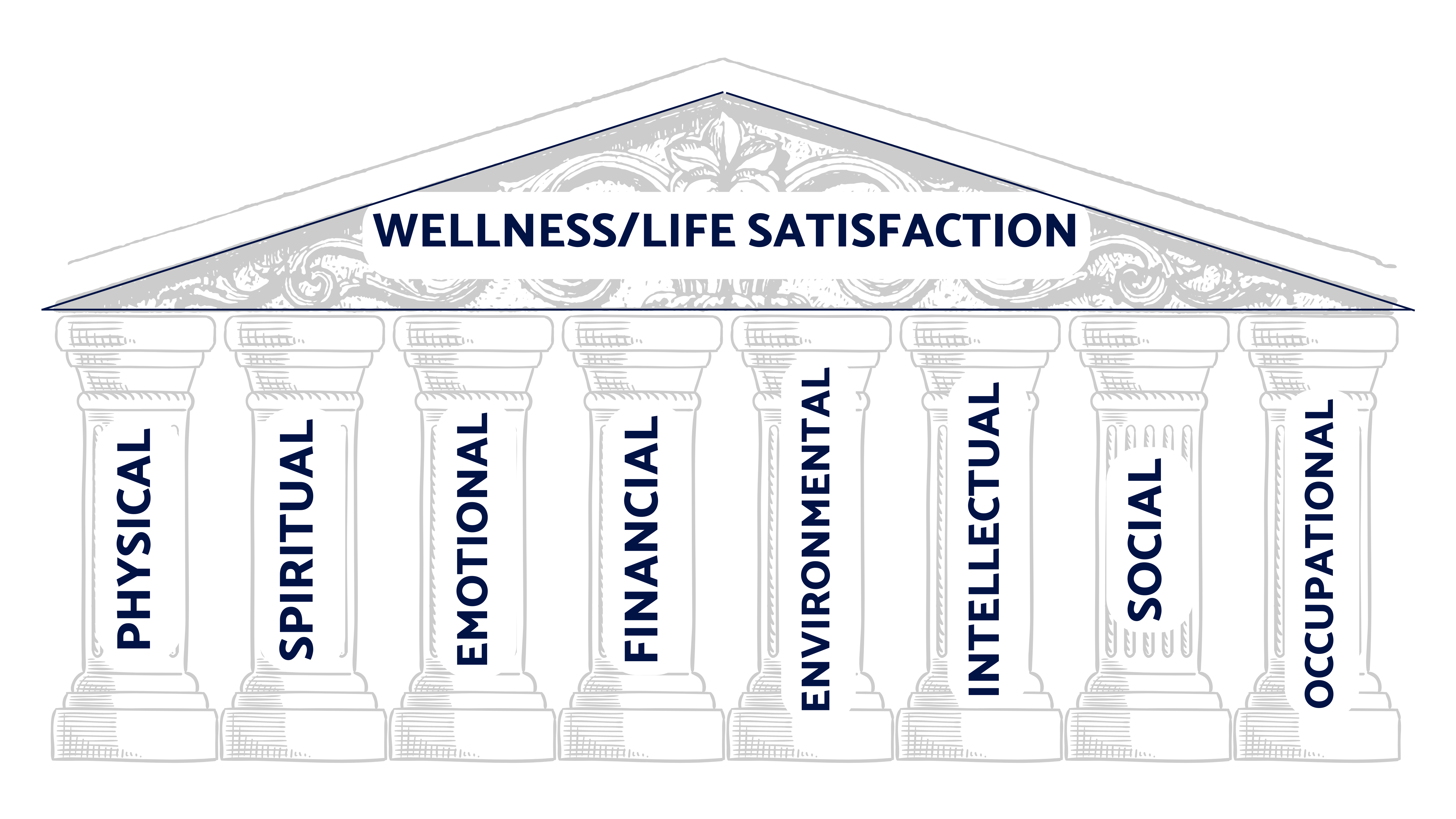
A widely accepted strengths-based model of wellness was created by Dr. Peggy Swarbrick. She categorizes wellness into 8 dimensions: physical, social, spiritual, environmental, intellectual, social, occupational, and financial. Some people utilize a wheel to visualize this model, but I tend to prefer thinking about it as pillars holding up your overall life satisfaction, as depicted below:

When you consider it this way, it’s easy to see that each of these dimensions plays a key role in improving and sustaining your life satisfaction. Each of these dimensions deserves a separate article, but here’s a brief summary of each of the dimensions.

Physical

Your physical wellness is composed of more than what initially may come to mind. Here is a short list of things that compose your physical wellness: how you fuel your body, the movement, and exercise you incorporate into your day, your physical strength, how much sleep you get, your resting heart rate, and your blood pressure. Having access to appropriate healthcare and accurate health information also falls within this category.

Spiritual

Your spiritual wellness can be separated into two parts. The first part is religious health. This refers to your connection with God or your religion. The second part is existential health. Existentialism refers to a way of thinking that encourages people to take responsibility for their lives and their choices. Oftentimes, people who study existentialism may say that when we can acknowledge death as a certainty, it can help provide clarity on how we want to make the most of life. In short, it refers to making meaning out of your life.

Emotional

Your emotional health is composed of the way you perceive yourself and your life, the way you are able to identify and regulate your emotions, your resilience, and your ability to have empathy for others. We all have Mental/Emotional health. It is possible to have bad mental health and NOT have a mental health diagnosis. It’s also possible to have a diagnosis and be really emotionally healthy! So much of our mental and emotional health is within our control to improve using skills that you can learn in therapy. Medicine helps sometimes, too!

Financial

Being financially healthy means being able to make & budget money in a way that will allow you to afford life’s necessities, as well as things that you may want. This looks different for everyone! There are plenty of finance gurus out there who can help you make sense of your finances. I am not one of those gurus! (Shout out to my favorite, Jen at Base Planning.)

Environmental

This category is multifaceted. It can allude to the physical spaces you inhabit (your room, your house, your place of work). Or it can allude to the communities you live in, or the earth as your environment. Either way, there’s always work to be done to foster an environment that increases your well-being and life satisfaction.

Intellectual

Intellectual health refers to how you’re using your brain. It involves activating your creativity, learning more about what interests you, and generally using your mind in a way that is fulfilling to you.

Social

Social wellness refers to your relationships. This could mean that you are making a point to be in trusting friendships. Or maybe it means being a supportive family member. This category also incorporates romantic partners – are you in or are you looking for a mutually trusting and satisfying relationship? Are there people in your life who push you away from health? Your social dimension of wellness should be pushing you more in alignment with your values.

Occupational

Occupational health is the feeling that you have had the opportunity to explore career options and have found one that is meaningful to you. Wellness in this category means that you find your work enriching and satisfying.

Life can be overwhelming, but being able to conceptualize wellness is the first step toward being able to create the life that you want. You can use these categories to assess yourself and then build out goals and habits that will increase your well-being in each category, and consequently your overall life satisfaction.

Sources:
Swarbrick, Margaret. (2012). Swarbrick, M. (2012). A Wellness Approach to Mental Health Recovery. In Recovery of People with Mental Illness: Philosophical and Related Perspectives. Abraham Rudnick,(ed). Oxford Press..